Insurance coverage depends on your policy, facts and insurer’s investigation. A contractor, inspector or website cannot promise approval. Your job is to protect people, notify the insurer, preserve evidence and keep repair decisions separate from coverage assumptions.
1. Address immediate hazards
Keep away from downed lines, unstable trees, structural movement, sagging ceilings and water near electricity. Use emergency services for life safety. Do not climb onto a storm-damaged roof.
2. Review the policy and contact the insurer
Locate the policy number, declarations, deductible and insurer contact. NAIC consumer guidance recommends notifying the company promptly when filing and asking the agent or insurer about deductible and process. Ask:
- What deadlines apply?
- What temporary measures are expected?
- Which photos, inventories and estimates are needed?
- Must damaged material be retained for inspection?
- May permanent work begin before inspection?
- How are emergency services documented?
Write down the claim number, contact, date and what was requested.
3. Document before cleanup when safe
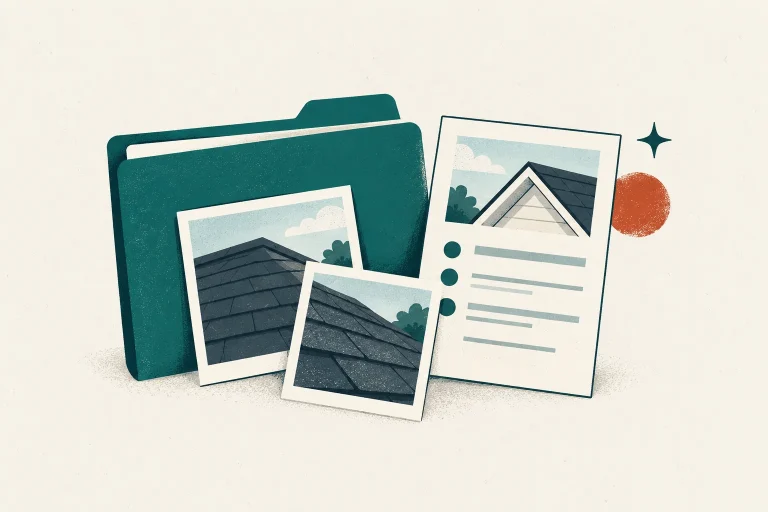
Take wide and close photos of affected and unaffected reference areas. Label direction, roof plane or room. Record date, time, weather, when damage was first noticed, prior condition and temporary measures. Photograph damaged belongings before moving or discarding them when health and safety permit.
FEMA advises photos and video of damage and keeping receipts. NAIC also recommends documenting losses before debris removal and saving damaged items for inspection where possible.
4. Prevent further damage without creating new risk
Policies commonly expect reasonable mitigation, but the exact obligation and reimbursable work vary. Ask the insurer first when possible. Use qualified help for exterior temporary work. Save before/after photos, invoices and proof of payment.
Do not interpret “mitigation” as permission to climb, perform permanent repairs or discard evidence.
5. Obtain evidence-based estimates
Request itemized proposals tied to visible locations and quantities. Each should identify materials, labor, flashing and accessory work, decking allowances, permits, disposal, cleanup, warranty, exclusions and change-order process.
The FTC recommends more than one estimate and warns not to rely on a contractor to decide insurance coverage. Refuse blank contracts, assignment language you do not understand, demands to sign over a check, or promises that the insurer “must pay.”
6. Compare inspection, contractor and adjuster documents
These records serve different purposes. Create a crosswalk:
| Location | Observed condition | Contractor scope | Insurer/adjuster treatment | Open question |
|---|---|---|---|---|
Ask for explanations of factual differences. Do not assume a repair estimate alone establishes cause, date of loss or coverage.
7. Keep a complete claim file
Save the policy, claim number, correspondence, call notes, original photos, reports, estimates, contracts, invoices, receipts, proof of payment and permit/warranty records. Follow phone conversations with written summaries.
If damage changes or concealed conditions emerge, contact the insurer or adjuster and ask about the process before authorizing added work.
Avoid adversarial scripts
Describe facts accurately and answer questions honestly. Do not exaggerate, coach contractors to use coverage language or hide prior conditions. If you disagree, use the insurer’s written review or appeal process and contact your state insurance department or qualified counsel for policy-specific guidance.
Related guide: Build the evidence file before cleanup with the storm-damage documentation workflow.
Sources
- NAIC: What You Need to Know When Filing a Homeowners Claim, notification and records; accessed October 17, 2026.
- NAIC: After the Storm, documentation, mitigation and assignment concerns; accessed October 17, 2026.
- FTC disaster contractor guidance, coverage and contract warnings; accessed October 17, 2026.
- FEMA damage-documentation guidance, photos and receipts; released April 16, 2025.
This article is general education, not legal, insurance or public-adjusting advice.