
Affiliate disclosure: RoofInspectionUSA may earn compensation from qualifying purchases when retailer links are activated. That would not change the price you pay. No compensated links are active in this draft. We have not hands-on tested these meters; our comparison uses current manufacturer specifications and published building-moisture guidance.
A moisture meter can help you map relative dampness, compare a suspect area with a known-dry area and track drying over time. It cannot prove that the roof is the source, show the route water took through a cavity or identify mold.
Our practical picks are:
- Klein Tools ET140 for non-destructive scanning across finished surfaces;
- General Tools MMD4E for low-cost pin readings where small holes are acceptable; and
- Extech MO55A for one instrument that can scan first and verify with pins.
Quick comparison
| Meter | Type | Published capabilities | Best fit | Main tradeoff |
|---|---|---|---|---|
| Klein Tools ET140 | Pinless | Material modes for drywall, masonry, hardwood and softwood; sensing depth up to 3/4 in | Mapping a broad relative pattern without punctures | Relative readings can be influenced by material layers and objects below the surface |
| General Tools MMD4E | Pin | 5–50% range for wood; 1.5–33% for building materials; 8 mm pins; calibration checker | Spot checks and drying comparisons where pinholes are acceptable | Reads only at pin contact/depth and damages the finish slightly |
| Extech MO55A | Pin + pinless | Pinless depth under 1 in; pin ranges for wood and building material; replaceable 8 mm pins | Scan-and-verify workflow with one meter | More settings and interpretation burden; pinless values remain relative |
Never use a meter on or near live electrical circuits unless its instructions explicitly permit the application. Klein’s ET140 warning states that it is not insulated and should never be used on or near live electrical circuits.
Best pinless scanner: Klein Tools ET140
Klein describes the ET140 as a pinless meter that uses an electromagnetic field to detect relative moisture content up to 3/4 inch deep. It provides modes for drywall, masonry, hardwood and softwood and is calibrated only for those materials.
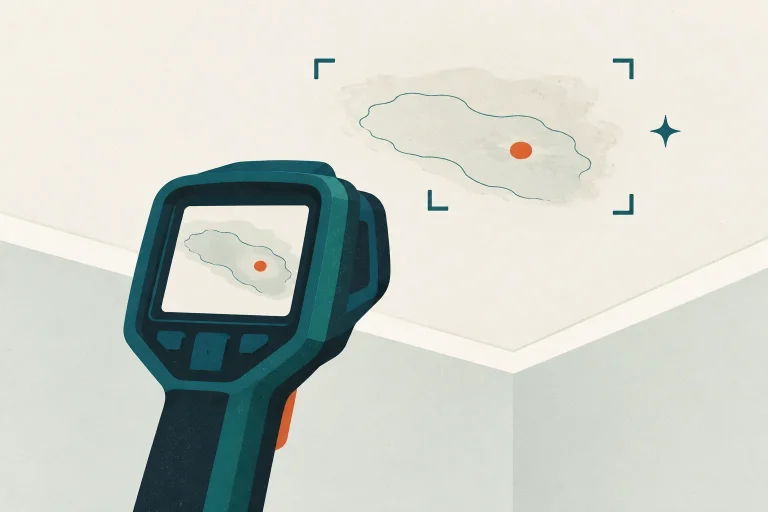
The chief advantage is coverage: you can scan a grid on a finished ceiling or wall without leaving holes. Start on a dry area of the same material and construction, then move toward the visible stain and record the pattern. A single number without a comparison is much less useful.
Good for: finding the apparent boundary of a damp pattern and monitoring whether the relative readings trend down.
Not good for: layered assemblies with metal, wiring, fasteners or different materials that can affect a capacitance-based reading; identifying the exterior entry point; testing air humidity.
Best budget pin meter: General Tools MMD4E
The MMD4E uses two 8 mm pins and lists measurement ranges of 5–50% for wood and 1.5–33% for building materials. Its cap doubles as a calibration checker, and replacement pins are available.
Pins measure a small, local area and can help verify that two visibly similar locations differ. They also leave holes. Obtain permission before using one on a finished surface, avoid known wiring or pipes and follow the manual.
Manufacturer documentation notes that wood readings are affected by ambient humidity and wood species. “Building material” percentages may be reported as wood-moisture equivalent rather than the material’s true water content. Treat them as instrument-specific comparison values, not universal pass/fail numbers.
Good for: repeatable spot comparisons and direct contact at pin depth.
Not good for: rapidly mapping a large finished ceiling; areas where punctures are unacceptable; inferring conditions deeper than the pins.
Best combination meter: Extech MO55A
Extech’s current MO55A combines a non-penetrating capacitance pad with replaceable 8 mm pins. The company lists pinless measurement depth under 25 mm (1 inch), relative pinless scales and pin ranges for wood and other building materials.
The value is workflow: scan a broader area in pinless mode, then—where safe and permissible—compare selected points using the pin mode. One instrument does not eliminate the need to choose the correct material setting or interpret layered construction.
Good for: homeowners or maintenance staff who expect both broad scanning and spot verification.
Not good for: anyone who wants a one-button leak locator. The meter still measures material response, not water’s travel path.
Pin vs. pinless: which should you buy?
Choose pinless if preserving a finished surface and mapping a broad pattern matter most. Choose pin if small holes are acceptable and you need a localized contact reading. Choose a combination instrument if you will actually use both methods and can manage the added settings.
For a one-time leak, hiring a qualified inspector or restoration professional may cost less than buying a high-end meter and learning to interpret it. A professional can connect measurements with roof, attic, plumbing, HVAC and building-envelope evidence.
A safer, more useful measurement process
- Control hazards first. Do not approach a bulging ceiling, active electrical hazard or unstable material.
- Read the manual. Confirm permitted materials, thickness, calibration check and electrical warnings.
- Choose a baseline. Measure a visibly dry location made of the same material, ideally nearby but outside the suspected pattern.
- Use a grid. Record points at consistent intervals instead of chasing the highest number.
- Repeat consistently. Use the same mode, orientation, pressure and location.
- Mark time and conditions. Indoor humidity, recent rain and drying equipment matter.
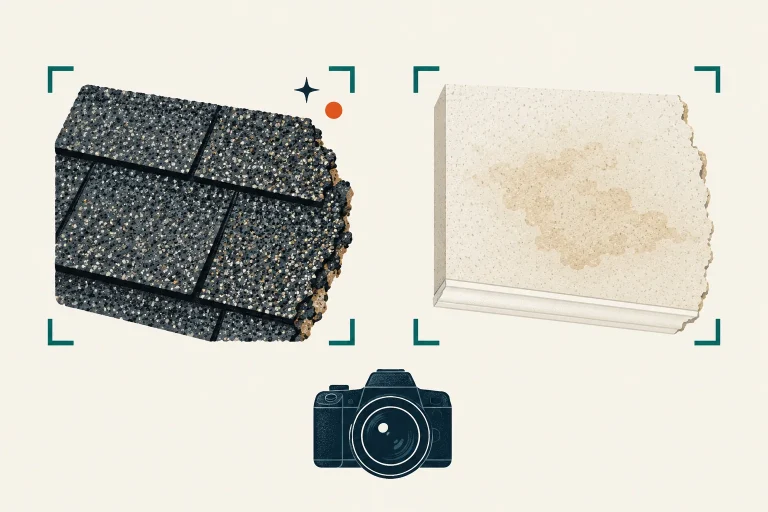
- Photograph the grid and display. Keep original images with the room and date.
- Verify the cause professionally. A wet pattern can come from roof entry, plumbing, condensation or another source.
The U.S. EPA explains that moisture meters can locate wet areas and monitor drying, while also noting that the material matters. Its moisture-control guidance cautions against treating a wood scale as a literal moisture percentage for materials such as gypsum board.
Common mistakes that create false confidence
- Comparing drywall with wood or masonry using the same mode
- Treating a pinless “percentage” as actual water by weight
- Scanning over metal corner bead, fasteners or hidden wiring without considering interference
- Measuring only the darkest part of a stain
- Assuming the wettest indoor point sits directly below the roof opening
- Declaring an area dry from one low reading
- Using the device as a mold test
EPA guidance says moisture meters can help locate hidden areas where mold may grow, not that they identify mold. If there is visible growth, odor, substantial water or a health concern, use qualified remediation and health guidance.
Our verdict
The Klein ET140 is the most practical first meter for broad, non-destructive homeowner comparisons. The General Tools MMD4E is a sensible inexpensive pin option when small punctures are acceptable. The Extech MO55A earns the combination pick for a scan-then-verify workflow.
Whichever you choose, use it as one evidence layer. Pair readings with a timeline, interior and exterior photos, material notes and an on-site inspection of the likely source.
Sources and methodology
- Klein Tools ET140 official product page, modes, depth, accuracy and safety warning; accessed October 17, 2026.
- General Tools MMD4E official product page, ranges, pins and calibration feature; accessed October 17, 2026.
- Extech MO55A official product page, measurement principles, depth and ranges; accessed October 17, 2026.
- EPA Mold Course, Chapter 3, moisture-meter applications; accessed October 17, 2026.
- EPA Moisture Control Guidance, material and WME interpretation; accessed October 17, 2026.
Method: editorial comparison of published specifications and method fit. No product was purchased, calibrated or performance-tested by RoofInspectionUSA.
Related guide: For the complementary imaging limits, read how thermal cameras are used when tracing roof leaks.